
Buying Guides / The essentials
Clothing and Shoe Fit: Measurements, Ease and Size Charts
Read size charts with confidence: distinguish body and garment measurements, compare clothes you own and check the shoe length and width that matter.
We may earn a commission from qualifying purchases. How affiliate links work
A familiar size is a starting point, not a fit promise. The useful question is whether this particular garment leaves the room you want in the places you need it. Separate your body measurements, the maker’s size chart and the dimensions of clothes that already work for you.
Start with the chart’s instructions
Check whether a chart describes the wearer’s body or the finished garment. A body chart helps select a nominal size; a garment chart describes the item itself. Do not compare a flat waistband width directly with a body circumference. Confirm units, measurement points and whether a measurement is taken relaxed or stretched before doing any arithmetic.
Levi’s own guide illustrates the distinction between measurement locations: waist, fullest seat and inside leg are separate measurements. Its conversions belong to its products; they are not a universal chart for all jeans or for another brand with a similar name. Follow the exact style’s chart when available. Levi’s measurement instructions.
Make a small personal measurement card
Record the date and units, then the measurements relevant to what you are buying. For a shirt or dress, note bust, waist and hip as directed by its chart. For trousers, add your preferred rise and inseam. For a jacket, shoulder position, upper-arm room and sleeve length may matter more than the size label alone. Keep these notes for yourself; there is no need to submit them to use this guide.
A soft tape should follow the chart’s stated location without being pulled tight. Do not change your posture to make a number smaller. If a measurement sits between chart rows, look at the intended silhouette and the restrictive area rather than automatically going up or down. A larger waist may also mean a larger shoulder or longer sleeve, which is not necessarily the change you need.
Compare a garment that already fits
Lay a suitable favorite flat without stretching it and record its measurements in the same way the seller does. For trousers, a favorite rise and inseam can be more informative than the size sewn inside. For tops, compare shoulder width, underarm width and shoulder-to-hem length. A short boxy shirt and a long narrow one can share a label size while behaving very differently.
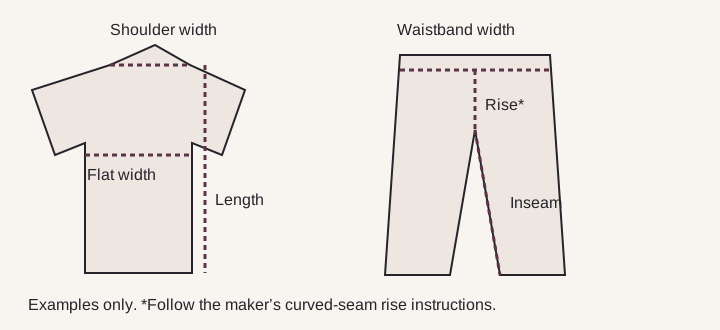
The diagram shows example measurement locations, not a sizing standard. A straight line across a flat garment is a width; doubling it gives an approximate circumference only where the maker’s method and garment shape make that appropriate. Curved, gathered, elasticated and wrap garments need their own instructions. Rise may be measured along a curved seam; it is not the same thing as a straight vertical distance.
Ease is room, not a better size
Positive ease means a garment is larger than the body at a given location. A hypothetical 40-inch finished bust around a 37-inch body provides three inches of circumference difference. Those example numbers prescribe neither a size nor an ideal allowance. The garment’s structure, stretch, layering and your preference decide whether the difference is useful.
Do not apply woven-shirt ease to a stretch knit or infer comfort from a stretch percentage. Room at the bust does not establish room at the upper arm. When trying an item under the retailer’s return conditions, sit, reach forward and bend your elbows; check whether the closures pull and whether the hem stays where you want it. Try an outer layer over the clothes you actually intend to wear beneath it.
Read fit reports as specific experiences
A helpful owner report identifies the style, size and fit problem: a tight upper sleeve, a gaping button or a waistband that slips while the hip fits. A general instruction to “size up” leaves too much unknown. Look for repeated reports about the exact cut and material, and compare the issue with your own priority measurement.
Colors, denim washes and production revisions may have different blends or measurements. Confirm the selected option’s chart and composition, not simply the first image in a shared listing. Petite, tall, curvy and relaxed are brand-defined labels; none substitutes for actual dimensions or guarantees a fit.
Shoes need length and width
Clarks advises tracing and measuring both feet while standing, with the socks intended for the shoes, then consulting its own chart. Length runs from heel to longest toe; width is measured across the broadest part. Keep each foot’s result and the units rather than assuming they match. Clarks’ measuring guide.
Use the exact maker’s width system. A letter or “wide” label is not a cross-brand measurement, and sizing up for width can introduce heel slip. A loafer’s heel retention and instep opening differ from an ankle boot’s shaft and fastening. Measure against the model’s information and assess both shoes; do not expect painful pressure to resolve through wear. No chart or owner’s comfort report can guarantee your fit.
Before committing to the pair or garment
Keep a short checklist: exact style and color, body versus garment chart, limiting measurement, planned layers or socks, and the selected offer’s return terms. Check when the return window begins, any condition requirements and who pays return costs. Do not assume every seller or every size has the same policy.
For the next decision, read the fabric and care label or map the clothes to your real week. Both are useful before adding anything to a cart.