
Buying Guides / The essentials
Plan a Small Wardrobe Around Your Real Week
Build useful outfit combinations from the clothes you already wear, then identify a genuine gap without a fixed capsule count or a mandatory shopping list.
We may earn a commission from qualifying purchases. How affiliate links work
A smaller wardrobe is useful only if it covers your life. Begin with the week you actually have: the clothes required for work, the things you reach for on ordinary days and the laundry you realistically complete. You may find a missing layer. You may also discover that you do not need to buy anything.
Write down occasions before items
Sketch an ordinary week and note the clothing demands, not an aspirational dress code. A day with a formal meeting needs a different outfit from a day spent doing errands. Add weather, travel between places and any need to change clothes. Do not let a rare occasion dictate every purchase unless it is genuinely difficult to dress for with what you own.
Separate requirements from preferences. A closed shoe required by a setting is different from a preference for loafers. Wanting a tucked shirt is different from needing one. That distinction makes it easier to spot alternatives already in your wardrobe.
Pull out the pieces you repeat
Choose the garments you actually wear and write down why they work. Perhaps a trouser stays comfortable when seated, a shirt fits under a jacket without bunching or a dress works with shoes already owned. These details are more useful than calling everything a “basic.”
Put uncertain pieces in a separate group while you plan; there is no requirement to discard them. Note whether the obstacle is fit, a missing partner, care or simple preference. Buying a second difficult garment rarely resolves the first one’s problem.
Draw outfit roles rather than a shopping list
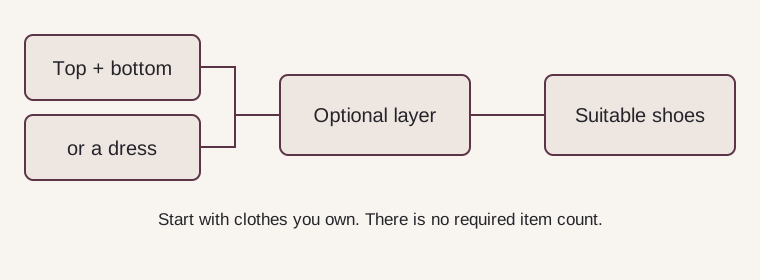
Use the diagram as a blank structure. A top plus a bottom is one route; a dress is another. Add a layer only if the setting or weather calls for it, then shoes that work with the hem and the occasion. These are roles, not compulsory garments or a target item count.
Try one favorite bottom with the tops you already own. Check the combination while sitting and moving, not just while standing in front of a mirror. Next try your likely layer. Sleeves that fit individually can bunch together; a longer shirt may sit awkwardly under a shorter jacket. Record combinations that work so you can repeat them without reconstructing the decision.
Let colors and proportions come from your favorites
A wardrobe does not have to be beige, black or uniformly neutral to be interchangeable. Start with combinations you enjoy wearing. Decide whether a prospective color connects with existing pieces rather than asking whether it belongs to an abstract capsule palette.
Likewise, there is no universal ratio of fitted to loose clothing. Look at where the waist, shirt hem, coat hem and shoe opening meet in the complete outfit. A useful change might be wearing a shirt open, changing a layer or choosing a different existing shoe rather than adding a new silhouette.
Plan around the laundry gap
Count the occasions between the care sessions you realistically complete. If all the tops you rely on are waiting to be washed at the same time, the issue may be timing or maintenance rather than the absence of an entirely new outfit. Do not prescribe repeat wear when a garment needs cleaning; plan with your actual habits and requirements.
Read each item’s instructions before including it in a frequent rotation. The FTC’s care-label guidance is a reminder that cleaning and drying directions belong to the particular garment, not its general category. Care-label guidance. A single hand-care piece may be manageable; a whole rotation needing separate attention may not fit your routine.
Name the smallest useful gap
Write a sentence with a role, a fit requirement and an existing partner: “I need a removable layer that fits over these two shirts and closes without pulling.” That is a more actionable brief than “I need more cardigans.” It may lead to an item you already have, an alteration inquiry or no purchase.
Before shopping, try the combination again with substitutes. If nothing works, set a total budget that includes any likely care or alteration expense. Do not count on a hypothetical cost-per-wear saving; future use is uncertain. A low price is not value if the garment never resolves the gap.
Use three final checks
Fit: Does the candidate work at the restrictive measurement and with the intended layers? Consult measurements, ease and size charts.
Upkeep: Can you follow the exact washing, drying and storage directions? Read fabric and care labels before assuming a blend is easy-care.
Offer: Is the chosen size and color available from the seller you expect, and can you meet the current return conditions? Do not assume another option on the same page has identical materials or terms.
Keep the outfit notes and use the clothes for your ordinary week. If they do the job, the exercise is finished without a shopping trip. If a gap persists, you now have a precise question to take to a comparison rather than a generic list of things everyone supposedly needs.